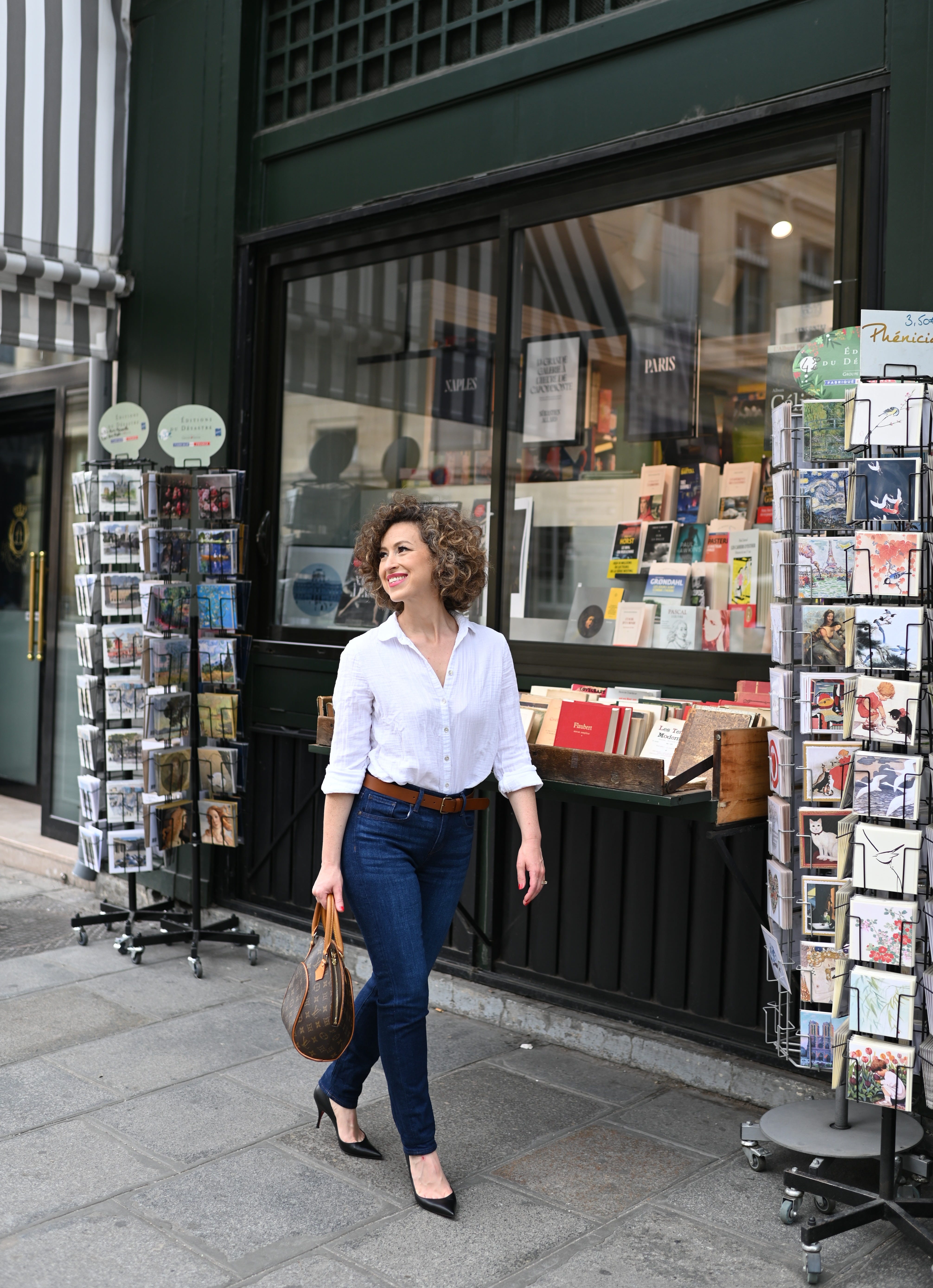
Ellie in Paris
Issue 160, featuring an interview with Ellie Krasne

Hello and welcome back to The Girl’s Guide! In case you’re new here: every other Friday, I interview an interesting woman, share something I’ve been thinking about lately, and recap the latest news at the intersection of pop culture and politics.
Find me on Instagram and X so you don’t miss any of my work.
Interview with Ellie Krasne
Today’s interview isn’t “Emily in Paris” — it’s Ellie in Paris! Meet Ellie Krasne, an American in Paris. Find her on Substack at Ellie is Based in Paris.
What does your life look like right now?
I run a strategic communications firm, Krasne Strategies, that works with non-partisan legal and policy organizations, so that keeps me busy. And, I teach strategic communications at a business school here in Paris. Most days involve writing, lots of reading, and meeting with clients. When I’m not doing that, I’ve found a great hot yoga studio in the center of Paris, and I love exploring the city — whether that’s a neighborhood wine bar or one of Paris’s many museums.
What’s the biggest lesson you’ve learned in your career?
Oy! Too many to mention. Stay humble, learn new things, and do the reading. So many people in communications avoid reading the white papers, legal filing, or the books. You’ll discover the nuggets everyone else missed, and they will become some of the most important parts of your message.
What are your favorite myths to bust about living and working in France?
1. The healthcare and daycare are free!
France has one of the highest tax burdens in Europe, and the average salary is about €43,000 before taxes, compared to roughly $64,000 in the U.S. People often talk about “free” systems without realizing the trade-offs.
2. The French don’t eat fast food.
Au contraire! France has the eighth-highest number of McDonald’s locations per capita in the world. Go to a grocery store around 6 p.m. and you’ll see plenty of parents negotiating chicken nuggets versus pasta with their kids — just like anywhere else.
3. Parisians are rude.
Okay, some are. But a big difference is they just are not as outgoing as us Americans.
What books are on your nightstand right now?
I am reading Lee Krasner’s biography by Gail Levin. Krasner was an Abstract Expressionist painter and child of Russian-Ukrainian immigrants. Oh, I just wrapped up Maureen Callahan’s Ask Not: The Kennedys and the Women They Destroyed, which is a fascinating glimpse into the Kennedy dynasty.

What’s your philosophy of style? Do you have any style icons?
Wear what flatters you. Everyone is different, and the goal is to wear what works with your shape and makes you feel confident.
I’m drawn to jewel tones, mid-rise jeans, and loafers. If I had to name a style influence, I’d probably say my late grandmother, she died when I was very little. She was always so put together — according to my mom, she gardened in pedal-pushers.
Fran Drescher gets an honorable mention.
A Manatee, a Mouse, and a Hillsdale Professor Walk Into a Bar
Yes, that’s the title of my latest book review. Read it below:
I’m certainly not the first person to remark upon this, but the chief moral fable of the United States—young George Washington admitting he chopped down a beloved cherry tree because he “can’t tell a lie”—is a far cry from the trickster tales passed down by peoples like the Yoruba in Africa, the Norse in Scandinavia, and the Apache in North America. The author Matthew Mehan acknowledges this in his new book for children and families, The American Book of Fables, writing, “In the time of America’s Founding, we praised less the creatures whose mouths were full of falsehoods and lies and more greatly honored the truth-tellers among us. But in other times and places, the liar is praised for his clever lies.” These tales’ morals don’t sit dormant in storybooks. They shape culture.
Mehan’s project comes as American culture has fractured. When neither politics nor religion seem able to bring us back together, perhaps long-forgotten folk tales and fables can. As the late American folklorist Barre Toelken noted, citing Samuel P. Huntington’s The Clash of Civilizations and the Remaking of World Order,
If we do not learn to deal positively and profitably with the multiplicity of cultures with which we now intersect, we will be living in an unrealistic and very problematic world. But [Huntington] speaks of culture and civilization as if these are properties which exist in and of themselves, expressed by paradigm and conscious philosophy; the work screams for the perspective of a folklorist or anthropologist, for the ongoing dynamics of vernacular ethnic worldview – with all its attendant assumptions and emotional loads – remain unexplored… Where are the folklorists when we need them?
The American Book of Fables, which is illustrated by John Folley, is a wide-ranging endeavor: a celebration of the Declaration of Independence’s 250th anniversary, a McGuffey Reader–style primer to introduce children to early American history, and an instrument of moral formation reimagining Aesop’s fables with distinctly American flora and fauna. CLICK HERE TO KEEP READING FOR FREE.
The Haps
Scandi Girl Summer
If, like me, you wish you could teleport directly into Matilda Djerf’s Instagram feed, then might I suggest trying out Scandi girl summer? I loved this Substack post titled “The Scandinavian Summer Wardrobe” that delves into not only what the Swedish girls are wearing, but how they think about buying and maintaining their wardrobe (hint: they’re minimalist, but not too minimalist).

Give Gen Z the Camera
I will not be watching Obsession because I have a very low tolerance for gore, and I might watch Backrooms if someone will tell me what the heck it’s about, but after reading up on the reactions to both of these films, I can say one thing: hand Gen Z the camera! I love that both of these projects are originals, too — something that younger viewers are hungry for after feeling like our only options at the theater are remakes or remakes of remakes. (Hence, my disappointment that one of the next projects Curry Barker, director of Obsession, will take on is a reboot of Texas Chainsaw Massacre. If you are wondering whether to watch Obsession, read my friend Steve Kapustka’s review here.
Here are more links to what I’ve been reading and listening to lately:
Techno Babel: Christians and the AI Problem, ft. Dr. Mark T. Mitchell (Moment of Truth): Patrick Henry College professor Mark T. Mitchell previews his forthcoming book.
America’s royal obsession (WORLD): The astute Emma Freire examines why we Americans just can’t quit our love of all things English.
I Can’t Afford To Thrift Anymore (Evie Magazine): Thrifting used to be a secret. Today, it’s a $56 billion industry, and the bargain is gone, writes Brooke Brandtjen.
James Ellroy: ‘It’s satanic to me, the dependency people have on computers’ (The Guardian): Ignore the title, this is a wide-ranging interview with Ellroy about his new novel and, believe it or not, his affinity for Richard Nixon.
Why Ballerina Farm polarizes women (Substack): Helen Roy is always a must-read.
Ask Evie
Have a question you want me to answer in the newsletter? Click this link to send your question anonymously, or use the button below!